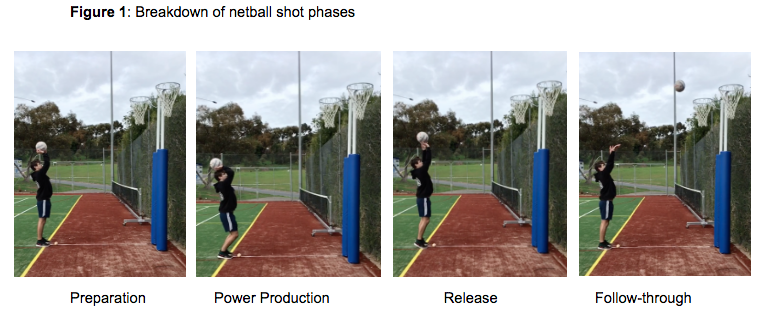
Preparation Phase
In order to achieve the optimal shooting technique for a netball shooter it is imperative that an effective and defined biomechanical preparation phase is adhered to and performed. The preparation phase of an accurate and effective netball shot requires the execution of 4 main biomechanical phases; being the base of support, establishing stability and balance and efficient centre of gravity.
Base of support
In order for the 4 biomechanical phases to work collaboratively to achieve the optimal shooting technique the execution of an initial adequate base of support is crucial. As shown in Figure 1 and 1a the following cues are critical when aiming for an accurate optimal shooting technique for a netball shot during this phase. Firstly, learners must place their feet in line with their shoulders, with their feet spaced hip width apart. Next, both feet should be placed parallel, directly pointing towards the goal ring. The learners trunk should be placed in an upright trunk position, and an upright head position that is directly in the midline of their body. Learners must place the netball slightly behind and high above their head to gain optimal technique. The ball should next be resting carefully on their finger tips of their preferred shooting hand, with elbows and knees slightly bent. To complete an effective base of support, the ball should be supported by the player’s second hand slightly on the side of the ball (Blazevich, 2010).
Stability and Balance
These recommended and identified cues detailed above and also shown in Figure 1 and 1a, demonstrate the optimal base of support that will provide and translate into effective stability and balance. These are crucial and fundamental biomechanical elements required for efficient skill execution of the shooting technique for a netball shooter during the first stage also known as the preparation phase. Research suggests that the foot placement during this phase produces not only a base of support but also stability and reduces trunk rotation (Steele, 1993). By decreasing this biomechanical element of trunk rotation the maintenance of head movement stability is more than likely to be successfully achieved, which overall will maximise correct technique and improve the accuracy of the shot. Netball shooters need to control their static balance not their dynamic balance as the body in this phase is not in motion. The balance can only be achieved when linked to their base of support which in this case is when a netball shooter has their feet planted, shoulder width apart and their trunk held upright with a stable head position. Steele (1993) suggests that this will keep a learner’s centre of mass beyond their base of support which will optimise stability. Most elite netballer’s naturally maintain the upright position leant backwards with their head slightly upright as well in the midline of their body, this has been found to successfully achieve a correct and optimal technique of a well balanced shooting stance (Steele, 1993).
Centre of Gravity
The final and yet equally important biomechanical element required to achieve the optimal netball shooting technique is establishing correct and effective centre of gravity,as mentioned above; a player’s stability is optimised when their centre of mass is beyond their base of support (Steele, 1993). Blazevich (2010) refers to the centre of gravity as the element which all particles in the body are evenly distributed and at any point we could place a weight vector is at the body’s centre of gravity. Figure 2 suggests that a low centre of gravity, linked to the base of support can improve a shooter’s overall stability. Correct centre of gravity ties together the above elements of support, stability and balance, enabling and ensuring efficient and even distribution of weight throughout the crucial preparation phase, increasing the likelihood of a higher level skill execution with the netball shooting technique.
In order to achieve the optimal shooting technique for a netball shooter it is imperative that an efficient preparation phase incorporating all four of the above biomechanical phases and principles is executed. To maximise the potential of this preparation phase translating into the accurate skill execution of the netball goal shot, all of these above four covered biomechanical elements need to be performed accurately, efficiently and collaboratively.
Release Phase
The release phase is the stage whereby the shooter has begun their upward projection motion, transferring the stored potential energy from their knees and arms and converting them into kinetic energy into the ball. For many athletes, this phase of the shooting motion can be the most difficult as it requires subtle actions, known as fine-motor movements, to transfer energy to parts of the ball to project it into the best suited flight path. This is where a majority of the “technique” notions come into play as any misplacement of hands, loss of stability or mistimed release speed and angle of the ball can result in a missed shot.
Kinetic Chain
A key principle that impacts the release phase of a netball shot is the kinetic (moving) chain. The kinetic chain refers to the sequential movement of joints and segments of a limb to transfer energy and produce force on an object (Blazevich, 2010). For a netball shooter, the kinetic chain impacts the outcome of a shot as it is the guiding feature in producing a straight-line movement. When looking to optimise a shot, it is imperative that the kinetic chain of the arm produces an action that guides the ball in a straight-line trajectory into the net to improve accuracy and goal conversion. The kinetic chain is also responsible for force generation on the ball. The force applied needs to be great enough so that it is able to combat the force of gravity (9.8 m/s2) and reach a peak of its trajectory above the rim before dropping into the net. However, it is crucial that not too much force is exerted on the ball as it would compromise the accuracy. A netball shot at a close proximity to the net can be identified as a push-like movement pattern as all of the joints and segments extend simultaneously to provide efficiency and accuracy (Blazevich, 2010). While potential energy is generated during the former phases, it is this stage which converts that potential energy into kinetic energy through the kinetic chain into the ball. Since the overall aim of this investigation is to optimise shot accuracy at goal, a push-like pattern would be best suited as it provides efficient and accurate straight-line movements to best achieve the intended outcome.
Projectile Motion
Once an object is released into the air on a given flight path it becomes a projectile on a trajectory. This trajectory, which has been established to be most optimal in a straight-line movement, is affected by the speed, angle and relative height of the release (Blazevich, 2010), which in turn impact the outcome of the shot. This is known as projectile motion and it refers to the motion of an object projected at an angle into the air (Blazevich, 2010). An example of how projectile motion works is when a ball is thrown straight up into the air (90°). While the ball may have a long flight time, at some point the force applied onto the ball will be less than that of gravity, forcing it to come straight back down exactly where it was thrown, effectively causing it to have little to no displacement. However, if that ball is thrown at an angle of 45°, the magnitude of both vertical and horizontal velocity would be equal, resulting in it being thrown at a lower height, but a longer distance (or greater placement). This obviously impacts the outcome of a shot but in order to establish the optimal trajectory we must first consider the factors that affect the release and trajectory.
As stated, the relative height of the athlete is a factor that has an immediate impact on the release of a shot. Research indicates that the optimal angle of trajectory is above 45° as a shooter is at a negative relative height to the rim, therefore requiring the shot to be angled upwards. Also, the relative distance to the goal also affects shot trajectory as the closer to the rim the shooter is, the greater the trajectory angle of release is needed to have it land in the hoop (Steele, 1990).
Magnus Effect
Once on its trajectory towards the net, there are still other factors that can affect the flight path of the ball, namely gravity and air resistance. The shape and texture of a projectile has a direct affect on the flight trajectory of an object due to the drag it creates. Drag is caused by the molecules of fluid (in this case air) collide with an object and take energy away from it (Blazevich, 2010). While we are unable to change the texture of the object, there are ways which an athlete can combat drag. Many, if not all, shooter place spin on a netball when being shot. This is achieved at the end of the kinetic chain through the fingers of the player. As the ball is being projected upwards through the arm movements, at the apex of the shot release shooters will flick their fingers as the ball is leaving their hand, placing a backwards spin on the ball. What this does is incorporate the Magnus effect into the shot, which causes an object to move in the direction according to the spin axis placed upon it (Blazevich, 2010). How this works is when a ball being shot is spun backwards towards the net, due to the friction between the air and the ball, air from the top of the ball is pulled around the same axis as the spinning ball, which is downwards (Huston & Grau, 2003). As evident in Figure 2, airflow at the bottom of the ball comes to a halt instead of being deflected upwards as it hits the spinning object. The net result of this is air being deflected downwards and due to Newton’s Third Law the air exerts an equal and opposite upward force, generating lift (Huston & Grau, 2003). This can attribute to the success of a shot in a couple of ways. Firstly, the spin exerted on a ball causes it to curve through the air by a different amount than by just gravity alone. Essentially allowing the ball to “hang” for longer and lose some of its energy before dropping down into the goal zone. If the shot is slightly off course and on a trajectory to hit the rim, the Magnus effect can also have benefits. As the ball collides with the rim, the momentum of the backwards spinning ball may influence the rebound into the rim as opposed to straight up or outwards. Steele (1990) suggests that the ideal amount of backspin for a netball shoot should be at least 1 to 1.5 spin rotations, projecting more spin may cause instability on force application, leading to a missed shot.

Figure 2: Magnus effect: air pressure conforming to spin of an object accumulates faster velocity (lower pressure). Drag of higher pressure causes deviation of shot (Blazevich, 2010)
Follow-through Phase
The follow-through phase is the final movement phase of the shot whereby the ball has left the hands of a player and on a trajectory towards the rim. During this phase, a player is attempting to regain stability after the shot, potentially re-readying themselves to jumps for a rebound or to set up for the next sequence of events. Due to the kinetic chain of movements for the technique execution, the player should also keep their hands in the air following the release of the shot. What this does is ensure the execution and lead up to the shot is completed in a straight line, culminating in the held position of release where a player keeps their dominant shooting hand adjusted in the flick pose towards the rim. Also, much like in the preparation phase of the shot, the shooter should keep their feet shoulder width apart. What this does is establish a solid centre of gravity, or mass (Blazevich, 2010), allowing the player to maintain a balanced position ready for the next movement action.
Figure 3: Hand release upon follow-through, amateur (left) and professional (right). Due to expertise, a professional shooter has more control/ability in dominant shooting hand, therefore requiring less stability from guiding hand.


